 ®
®
.jpg)
About Charles.
Occupational therapist. Fifteen years in NHS neurorehabilitation. Author of Mindfulness-Informed Fatigue Management.
Diagnosed with ADHD as an adult, while working in brain injury rehabilitation. Which explained quite a lot.
My dad died when I was 17.
He drowned on holiday. I was studying A-levels in chemistry, physics, and biology, planning to follow him into medicine. After he died, everything changed and I switched to psychology. It took me five years to finish a three-year degree. I spent most of it ashamed I wasn't keeping up.
What I didn't know at the time was that my brain was running on five concurrent thought streams. Not one at a time, switching between them. Five at once, all day. I assumed everyone's brain was like this, because how would I know any different?
I was diagnosed with ADHD in my forties. It explained a lot.
Occupational therapy saved my life.
I'm not being dramatic when I say that.
In the years after my dad died, one thing that kept me here was my friends pulling me out of the house — to play football, go to the pub, do anything that wasn't sitting alone with my thoughts. Doing things, with other people, was the difference.
That's what occupational therapy is, in a way. The clinical definition is longer, but the heart of it is helping people get back to doing the things that matter to them, with the support they need.
I qualified, worked for ten years in busy NHS hospital settings, and was exhausted by most of them — the lights, the noise, the stress of people in the worst moment of their lives.
Momenting emerged from personal experience of trauma, fatigue and recovery, years of neurorehabilitation practice, and a simple observation: the moments that most support wellbeing are often the moments we are most likely to miss.
Finding the thing that helped.
I did an eight-week Mindfulness-Based Stress Reduction course. I didn't expect much of it. Sitting still had never been my thing.
It worked. Not because it was magic, but because it slowly retrained how my attention worked, and gave me a quieter relationship with the parts of me that wouldn't stop trying. I started meditating daily. I still do.
Over the next ten years I trained more formally, worked with hundreds of people in brain injury rehabilitation, and slowly built what became the Mindfulness-Informed Fatigue Management course.
The book.
In 2026, the course became a book — Mindfulness-Informed Fatigue Management. It carries endorsements from people whose work I deeply respect: Tina Vaughan, Ellie Sturrock, Rob Gebka, and Professor Birgit Gurr, my clinical lead through much of my NHS career.
Birgit is the reason a lot of this exists. She nurtured generations of clinicians, gave us the space to develop courses, and never needed to take credit for what came out of it. So much of what I know about being a clinician, I learned from her.
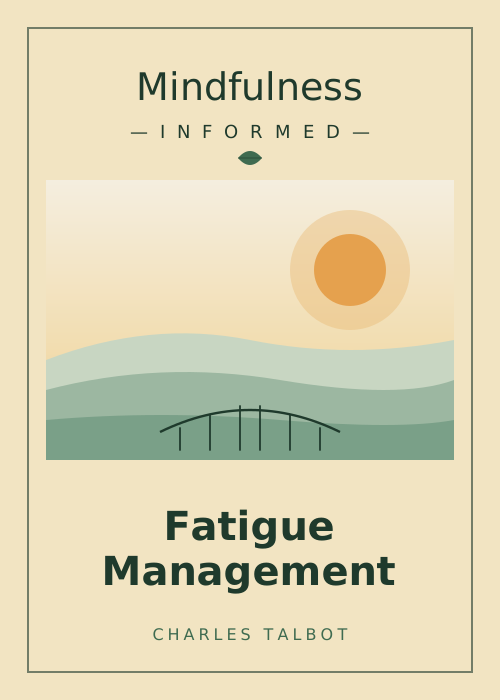
A book to take with you.
Mindfulness-Informed Fatigue Management is the whole course in book form — Charles's eight-week programme, including QR-linked videos and guided meditations to work through at your own pace, on your own or alongside the course or one-to-one sessions.
£30. Available now in paperback and ebook.
How Momenting got its name.
For years I taught this as mindfulness, because that's what it is.
Over time, I noticed that some people arrived with assumptions about what mindfulness meant. They imagined emptying the mind, adopting a belief system, or becoming someone different from themselves.
Yet many of those same people later discovered that mindfulness was a life-changing skill.
Much of the time we live in what I call the Current Moment, caught up in thoughts, worries, plans, habits, and automatic reactions. We are physically here, but our attention is somewhere else.
Momenting is the practice of coming back to the Present Moment, where we are aware, connected, and fully conscious.
I wanted a word that described that experience. Not a concept. Not a theory. A verb. Something you do. So I called it Momenting.
Because life doesn't happen in our thoughts about the moment. Life happens in the moment itself.

The other things.
I write poetry, sometimes I perform it. I play guitar badly and write songs. I have a young family so muck around and play a lot. I meditate for about an hour every morning, before everyone else is up.
I care about homelessness. I worked for a year and a half as a mental health practitioner in homeless health, and it's stayed with me. One of the long-term hopes for this work is to train people with lived experience — including people who've come through homelessness — to deliver resilience training to others in the same position.
Credentials, for the people who want them.
- HCPC registered occupational therapist.
- Member of the Royal College of Occupational Therapists.
- Member of BAMBA, the British Association of Mindfulness-Based Approaches.
- 0 years in NHS neurorehabilitation.
- Internal Family Systems-informed practitioner (12-day foundation training).
- Author of Mindfulness-Informed Fatigue Management (2026).
- MIFM course endorsed by the Counselling and Psychotherapy Central Awarding Body (CPCAB) for 16 hours of CPD.
Standing on the shoulders of giants.
None of this work is mine, really. The principles go back thousands of years in contemplative traditions. The clinical translation owes everything to people like Jon Kabat-Zinn, Richard Davidson, Zindel Segal, Judson Brewer, and Kristin Neff. My own teachers, and the peer specialists I've worked alongside, taught me more than anyone.
I'm a guide. The path's been there a long time.
If you'd like to work with me.

Have a chat first.
Thirty minutes on the phone or on Zoom. No charge. No obligation. We work out together whether anything I offer might help.
Pick a time that suits you →